<< Return to News

Resolving Toxic Upsets: Quats in Wastewater

Earlier in this article series, we touched on how bioaugmentation treatments for wastewater have been around for 50+ years to help resolve toxic upsets. We also explored how Bacillus, a certain genus of bacteria that can be used in microbial treatments, are resilient to oxidizers.

Today, we’ll examine how Bacillus are resistant to another powerful but non-oxidizing anti-microbial: Quats.

What are Quats?

Quaternary ammonium compounds (QAC, also referred to as “Quats”) are potent disinfectant ingredients found in both household and industrial cleaners. Some common examples are benzalkonium chlorides (BAC, BZK, BKC), alkyl dimethyl benzyl ammonium chlorides (ADBAC) and several other compounds identified by the words ‘ammonium chloride’ at the end of their names.

How Quats Work

Quats kill bacteria by puncturing or disorganizing the cell membrane, leading to interior component leakage and ultimately cell death. The use of Quats is especially common in food processing plants as tools for combating bacterial growth and contamination in the end-product. While this is effective for facility sanitization, it can potentially lead to problems in wastewater systems as they depend upon their inherent microbial community to function properly.

Effects of Quats in Wastewater

When a toxic substance like a Quat enters a wastewater system, it can drastically alter the microbial community, having a potentially major negative impact on the entire system. The main job of bacteria in wastewater is to digest organic material and remove it from the water. If a large portion of the bacterial population is wiped out by Quats, it can dramatically slow treatment, leading to disfunction and costly recovery expenses.

Resolving Toxic Upsets

To help resolve toxic upsets, wastewater facilities can treat their systems through bioaugmentation with Bacillus. Some Bacillus strains can survive high levels of Quats as well as degrade some quats into less toxic compounds. Additionally, some Bacillus can produce an enzyme called amine oxalase that gives them the ability to cleave Quats into smaller compounds with a much lower level of toxicity. The whole microbial community is involved in getting the wastewater environment back to where it was prior to an upset and the presence of Bacillus can give the system the kickstart it needs.

The below experiment (Figure 1) illustrates the recovery that’s possible with our Bacillus-based treatment Biotifx®. In the untreated wastewater sample containing Quats, the microbial community struggled to grow. The Biotifx treated community recovered quickly resulting in minimal performance interruption.
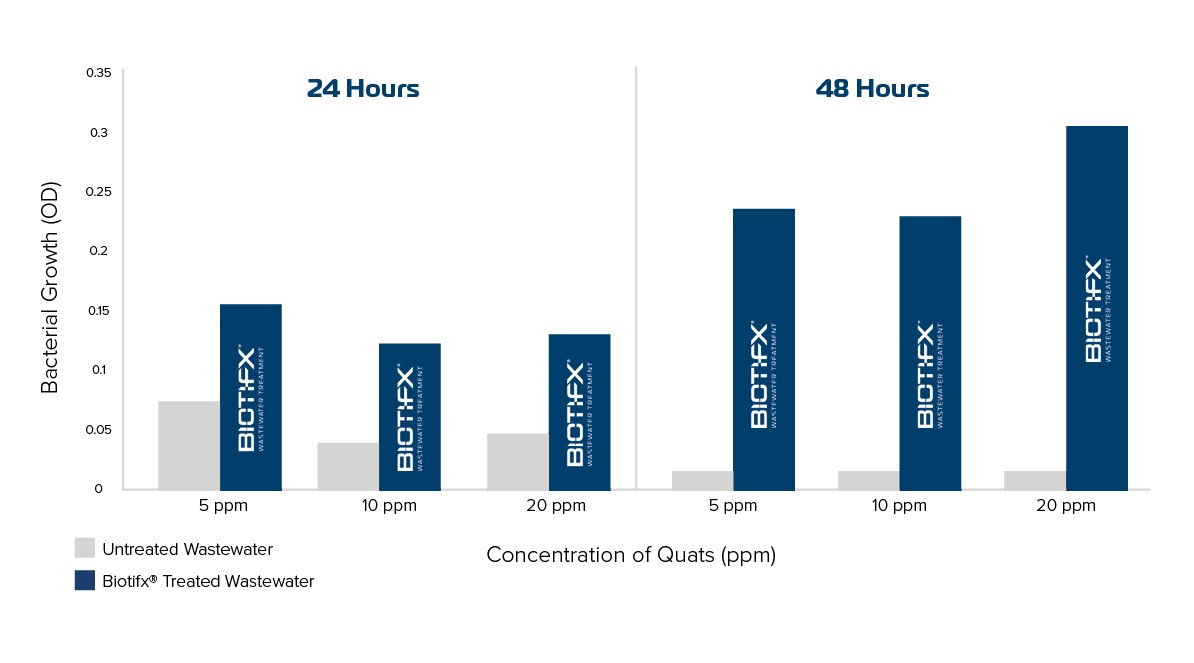
Figure 1: Bacterial growth in wastewater challenged with varying levels of Quats with and without Biotifx treatment.

For more information about our Biotifx products and distribution program, contact us and one of our wastewater experts will reach out to you.
Search Insights
Recently Posted Insights

MDG: Partners in Plant Health

At MDG, our mission is to Feed, Clean, Save the World through the development of microbial solutions that solve significant challenges in the markets we serve. We’re excited to continue working toward our mission by igniting our presence in the plant health market!...

MDG Selected as a Finalist in 2025 Wisconsin Innovation Awards

We are excited to share that, for the second consecutive year, we’ve been chosen as a finalist for the Wisconsin Innovation Awards (WIA)! This annual award is granted to companies and individuals developing groundbreaking ideas and driving innovation in the state of...

Upcoming Webinars: Putting Bacillus to Work

https://vimeo.com/1115971375?share=copy Bacillus bacteria are highly versatile, making them a great choice for formulating industrial, institutional, and consumer (IIC) cleaning products. During our upcoming webinar, technical support lead Jennifer Cray will use MDG...

Tips for Successful Microbial Scale-Up

Scaling up your microbial strain for commercial purposes is a highly complex process, and without the proper guidance, it can be hard to get it right. As your trusted CMO for custom microbial fermentation, we work with you to achieve your unique goals and drive your...

Meet MDG at SupplySide Global 2025

Heading to SupplySide Global in Las Vegas this year? So are we! On October 29 and 30, our human health expert will be walking the expo hall floor. Don’t miss your chance to connect in person and learn about how MDG can become your trusted probiotic ingredient...

Celebrating Our Expanded Capacity for Microbial Growth and Scale-Up

https://vimeo.com/1127921161?share=copy As a trusted provider of Bacillus-based solutions, we are passionate about continuous innovation to better serve our partners. After years of planning and hard work, we are thrilled to share that we celebrated the grand opening...

MDG at RAFT 2025: Insights on Innovative Microbial Manufacturing

https://vimeo.com/1119814916?share=copy MDG is excited to share that we will be exhibiting at the Recent Advances in Fermentation Technology (RAFT) Conference this year! Visit us November 9–12 at the Marriott Myrtle Beach Resort and Spa in Myrtle Beach, SC. We’ll be...

Biotifx®: Innovating Wastewater Solutions

Without the right support, launching and selling your biological wastewater treatment products can be a difficult task. Luckily, when you partner with MDG, you receive the necessary assistance and more through our Biotifx® Platform. Created specifically for value-add...

Inflammaging: How Probiotics Can Help

Healthy aging is an essential element of wellness for many consumers—in fact, in a NutraIngredients survey, 50% of people ranked healthy aging as an important goal. Unfortunately, there are a multitude of factors that may impede the healthy aging process. Recent...

Related News