<< Return to Industry Reflections

Resolving Toxic Upsets: Quats in Wastewater

Earlier in this article series, we touched on how bioaugmentation treatments for wastewater have been around for 50+ years to help resolve toxic upsets. We also explored how Bacillus, a certain genus of bacteria that can be used in microbial treatments, are resilient to oxidizers.

Today, we’ll examine how Bacillus are resistant to another powerful but non-oxidizing anti-microbial: Quats.

What are Quats?

Quaternary ammonium compounds (QAC, also referred to as “Quats”) are potent disinfectant ingredients found in both household and industrial cleaners. Some common examples are benzalkonium chlorides (BAC, BZK, BKC), alkyl dimethyl benzyl ammonium chlorides (ADBAC) and several other compounds identified by the words ‘ammonium chloride’ at the end of their names.

How Quats Work

Quats kill bacteria by puncturing or disorganizing the cell membrane, leading to interior component leakage and ultimately cell death. The use of Quats is especially common in food processing plants as tools for combating bacterial growth and contamination in the end-product. While this is effective for facility sanitization, it can potentially lead to problems in wastewater systems as they depend upon their inherent microbial community to function properly.

Effects of Quats in Wastewater

When a toxic substance like a Quat enters a wastewater system, it can drastically alter the microbial community, having a potentially major negative impact on the entire system. The main job of bacteria in wastewater is to digest organic material and remove it from the water. If a large portion of the bacterial population is wiped out by Quats, it can dramatically slow treatment, leading to disfunction and costly recovery expenses.

Resolving Toxic Upsets

To help resolve toxic upsets, wastewater facilities can treat their systems through bioaugmentation with Bacillus. Some Bacillus strains can survive high levels of Quats as well as degrade some quats into less toxic compounds. Additionally, some Bacillus can produce an enzyme called amine oxalase that gives them the ability to cleave Quats into smaller compounds with a much lower level of toxicity. The whole microbial community is involved in getting the wastewater environment back to where it was prior to an upset and the presence of Bacillus can give the system the kickstart it needs.

The below experiment (Figure 1) illustrates the recovery that’s possible with our Bacillus-based treatment Biotifx®. In the untreated wastewater sample containing Quats, the microbial community struggled to grow. The Biotifx treated community recovered quickly resulting in minimal performance interruption.
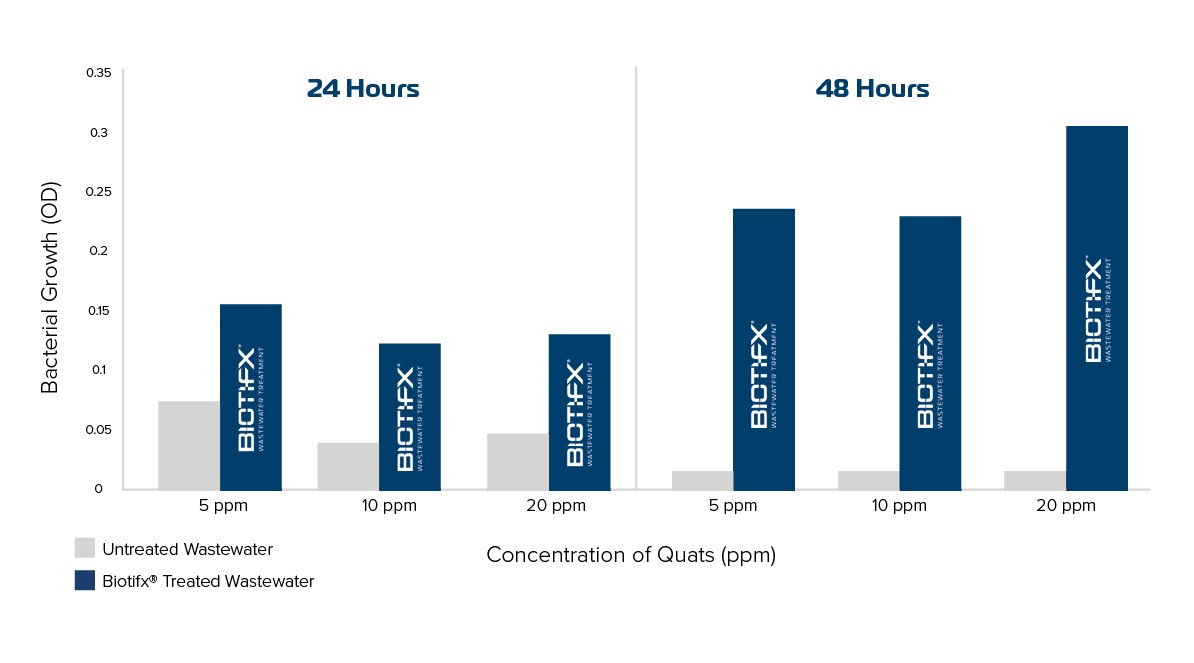
Figure 1: Bacterial growth in wastewater challenged with varying levels of Quats with and without Biotifx treatment.

For more information about our Biotifx products and distribution program, contact us and one of our wastewater experts will reach out to you.
Search Insights
Recently Posted Insights

MDG’s Trusted Process in Developing Probiotic Ingredients

We apply our Trusted Process to everything we do, and we customize the individual steps for each market we work in. In the human health market, for example, the process of developing and manufacturing high-quality probiotic ingredients may look different from our...

MDG Exhibits at Biostimulants World Congress 2024

We are excited to announce our upcoming attendance at the 2024 Biostimulants World Congress, the largest international biostimulants event dedicated to the latest advancements and innovations in the plant health industry. The event takes place in Miami, Florida,...

Planning Ahead: Start Early with Your Custom Fermentation Partner

At MDG, we are dedicated to helping you scale up your bacterial ingredients efficiently and economically so you can find success in your microbial product lines. The process of formulating those product lines can include quite a few steps. You need to identify your...

Optimize Water Quality with Bioaugmentation: MDG Webinar Recap

As experts in Bacillus, we’re dedicated to teaching our partners and potential customers about bioaugmentation and its benefits in the wastewater industry. Throughout the year, our microbiologists and technical support leads host webinars on a wide range of topics,...

MDG’s Wastewater Team Attends WEFTEC 2024

We are excited to announce our attendance at WEFTEC 2024, the largest annual water quality event in North America, taking place October 5–9 in New Orleans. As leaders in bioaugmentation with Bacillus, we will be showcasing our innovative solutions designed to improve...

Under the Microscope with Praful Aggarwal

At MDG, Real Science matters; it is our foundation. Our teams conduct rigorous, market-informed research and development while innovating new solutions for our partners. Let’s hear from Praful Aggarwal about what it’s like to be an Associate Research Scientist at MDG....

Choosing the Best Drying Technique for Custom Fermentation

https://vimeo.com/1005990338/65637cf06c?share=copy MDG has the resources and production capacity to meet your custom fermentation needs, helping you create a high-quality microbial product for your formulations. With decades of experience in microbial manufacturing,...

Industry Reflections

Bacillus, Distinguishing Species and Strains Part I

Bacillus Species Identification Methods: Definitions, Pros, and Cons Understanding the effectiveness of Bacillus products is easy to understand because in many cases we can visibly see the difference. But, it is hard to see what exactly makes up the product. Like most companies, you have probably asked suppliers “what

Fats, Oils and Grease: Bacillus vs. The Alternatives

What do many commercial, residential, industrial and institutional facilities all have in common? If you said a door, you’re technically correct; but for the purpose of today’s article the correct answer was Fats, Oils and Grease (FOG)! All of your customers facilities have drains, and drains are sought-after hosts

Bioaugmentation

What is bioaugmentation?

At MDG, we continue to discover all the possibilities to treat wastewater with Bacillus. Through years of research and development, we’ve found that bioaugmentation is the answer for wastewater treatment. Bioaugmentation is the process of adding scientifically selected organisms to a microbial community to enhance that community. The term bioaugmentation

Pulp and Paper Lagoons Problems

It’s been a tough few years for the pulp and paper (P&P) industry. With an increase in foreign competition and a lowered demand for paper, many facilities have had to tighten their belt. One of the most probable victims of these cuts are the wastewater treatment systems. Wastewater needs

Supplying Quality: One Strain at a Time

In the large-scale liquid bacterial fermentation world, there are two primary ways to grow bacteria: as individual strains or in combination with others. At Microbial Discovery Group, we grow one strain at a time as it has served us well over the past decade. Truth be told, if I

News and Insights

The Benefits of Liquid Dosing

Many wastewater distributors are faced with finding an efficient product to combat common challenges such as sludge, fats, oils, and grease, and odors. Bacillus-based products have been proven highly effective and reliable to reduce, eliminate, and alleviate these challenges in the wastewater market. Did You Know These Products Come in

Are You Offering a Bacillus RV Septic Treatment?

Outdoor activities like RV camping are an ideal way for travelers to escape indoor isolation. It’s all about packing up the necessities and hitting the open road. Living out of an RV camper for any amount of time will likely include eating, sleeping, and using the bathroom. These are

Top 5 Tips to Prevent Septic System Back-Ups

According to the EPA, about 1 in 5 US homes depend on septic systems, and with the uptick in professionals working from home, septic tank maintenance and backup prevention tips are among some of the top online searches. Septic service companies are in high demand, more people are home

FAQs on Bacillus Strains in the I&I Market

1. How do MDG’s Bacillus strains help reduce a variety of organic materials such as debris, decaying food, human and pet waste and FOG? MDG offers Bacillus-based products with different Bacillus strains that have a wide array of capabilities. Bacillus are living organisms and need food to live and multiply. They break down and consume