<< Return to Industry Reflections

Are you over-preserving?

Many of us know what happens when you mistakenly under-preserve a biological product: the bottles start to bulge or suck-in (the latter can also be caused by fragrance issues), fungal growth starts to appear or it starts to have an unpleasant odor. But do you know what signs to look for if your product is over-preserved?

There is usually one noticeable sign of an over-preserved product: the customers who were consistently using your product haven’t placed an order in a while.

Understanding Preservatives

The preservation system in your biological product is a double-edged sword. If you under-preserve, you get the problems mentioned above. But if you over-preserve, your product won’t work, or it will have a significant delayed reaction. This can lead some of your repeat customers to think that the product no longer works.

Over-preservation occurs when too high of a concentration of preservatives is present in a product. The preservatives are meant to be diluted to a predetermined point as indicated by the number in front of the X on the label (i.e. a 10X product would be 1 part product, 9 parts water). Diluting to the proper point allows the product to activate and begin working. If over-preserved, the product isn’t diluted enough to allow activation.

Effects on Application

The below graph (Figure 1) shows an example of an over-preserved product. As you can see, the properly preserved product began to grow 16 hours sooner than the over-preserved product. Depending on the application and holding time, a delayed start like that of the over-preserved product can kill your treatment success. Grease traps, multi-story drain treatments and septic piping are a few examples of systems that have narrow activation windows where over-preservation can limit your repeat business.

At MDG, we’re dedicated to honoring the brand and reputation of our partners. Proven Success is our measure of a job well done and is our promise. As one of our partners, we’ll show you how to properly dilute products so that you can avoid getting over- or under- preserved products. If you suspect issues with your current supplier, reach out to us and we’ll see what we can do to help.

If you’d like to learn more about our products and support services, send us a message and one of our representatives will reach out to you.
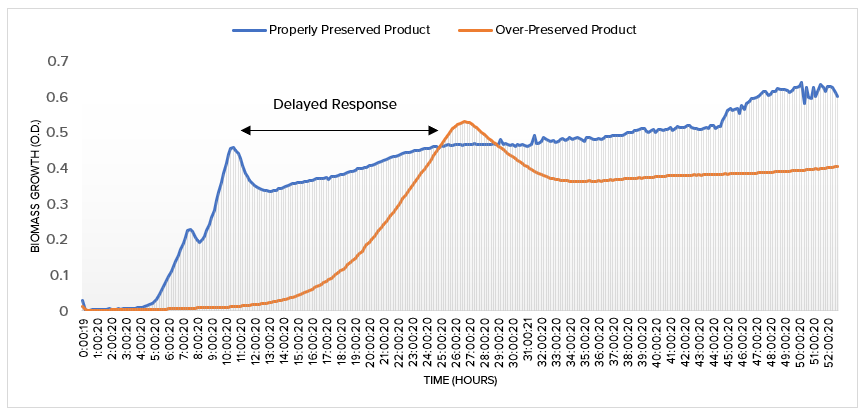
Figure 1 – This graph illustrates how an over-preserved product can have a negative impact on product application. If over-preserved, the product may not work, or it will have a delayed reaction which can have a negative impact on treatment.


Search Insights
Recently Posted Insights

MDG’s Trusted Process in Developing Probiotic Ingredients

We apply our Trusted Process to everything we do, and we customize the individual steps for each market we work in. In the human health market, for example, the process of developing and manufacturing high-quality probiotic ingredients may look different from our...

MDG Exhibits at Biostimulants World Congress 2024

We are excited to announce our upcoming attendance at the 2024 Biostimulants World Congress, the largest international biostimulants event dedicated to the latest advancements and innovations in the plant health industry. The event takes place in Miami, Florida,...

Planning Ahead: Start Early with Your Custom Fermentation Partner

At MDG, we are dedicated to helping you scale up your bacterial ingredients efficiently and economically so you can find success in your microbial product lines. The process of formulating those product lines can include quite a few steps. You need to identify your...

Optimize Water Quality with Bioaugmentation: MDG Webinar Recap

As experts in Bacillus, we’re dedicated to teaching our partners and potential customers about bioaugmentation and its benefits in the wastewater industry. Throughout the year, our microbiologists and technical support leads host webinars on a wide range of topics,...

MDG’s Wastewater Team Attends WEFTEC 2024

We are excited to announce our attendance at WEFTEC 2024, the largest annual water quality event in North America, taking place October 5–9 in New Orleans. As leaders in bioaugmentation with Bacillus, we will be showcasing our innovative solutions designed to improve...

Under the Microscope with Praful Aggarwal

At MDG, Real Science matters; it is our foundation. Our teams conduct rigorous, market-informed research and development while innovating new solutions for our partners. Let’s hear from Praful Aggarwal about what it’s like to be an Associate Research Scientist at MDG....

Choosing the Best Drying Technique for Custom Fermentation

https://vimeo.com/1005990338/65637cf06c?share=copy MDG has the resources and production capacity to meet your custom fermentation needs, helping you create a high-quality microbial product for your formulations. With decades of experience in microbial manufacturing,...

Industry Reflections

Bacillus, Distinguishing Species and Strains Part I

Bacillus Species Identification Methods: Definitions, Pros, and Cons Understanding the effectiveness of Bacillus products is easy to understand because in many cases we can visibly see the difference. But, it is hard to see what exactly makes up the product. Like most companies, you have probably asked suppliers “what

Fats, Oils and Grease: Bacillus vs. The Alternatives

What do many commercial, residential, industrial and institutional facilities all have in common? If you said a door, you’re technically correct; but for the purpose of today’s article the correct answer was Fats, Oils and Grease (FOG)! All of your customers facilities have drains, and drains are sought-after hosts

Bioaugmentation

What is bioaugmentation?

At MDG, we continue to discover all the possibilities to treat wastewater with Bacillus. Through years of research and development, we’ve found that bioaugmentation is the answer for wastewater treatment. Bioaugmentation is the process of adding scientifically selected organisms to a microbial community to enhance that community. The term bioaugmentation

Pulp and Paper Lagoons Problems

It’s been a tough few years for the pulp and paper (P&P) industry. With an increase in foreign competition and a lowered demand for paper, many facilities have had to tighten their belt. One of the most probable victims of these cuts are the wastewater treatment systems. Wastewater needs

Supplying Quality: One Strain at a Time

In the large-scale liquid bacterial fermentation world, there are two primary ways to grow bacteria: as individual strains or in combination with others. At Microbial Discovery Group, we grow one strain at a time as it has served us well over the past decade. Truth be told, if I

News and Insights

The Benefits of Liquid Dosing

Many wastewater distributors are faced with finding an efficient product to combat common challenges such as sludge, fats, oils, and grease, and odors. Bacillus-based products have been proven highly effective and reliable to reduce, eliminate, and alleviate these challenges in the wastewater market. Did You Know These Products Come in

Are You Offering a Bacillus RV Septic Treatment?

Outdoor activities like RV camping are an ideal way for travelers to escape indoor isolation. It’s all about packing up the necessities and hitting the open road. Living out of an RV camper for any amount of time will likely include eating, sleeping, and using the bathroom. These are

Top 5 Tips to Prevent Septic System Back-Ups

According to the EPA, about 1 in 5 US homes depend on septic systems, and with the uptick in professionals working from home, septic tank maintenance and backup prevention tips are among some of the top online searches. Septic service companies are in high demand, more people are home

FAQs on Bacillus Strains in the I&I Market

1. How do MDG’s Bacillus strains help reduce a variety of organic materials such as debris, decaying food, human and pet waste and FOG? MDG offers Bacillus-based products with different Bacillus strains that have a wide array of capabilities. Bacillus are living organisms and need food to live and multiply. They break down and consume